Carova Beach Brief
Currituck County — Carova Beach
“4x4 beach living on the northern Outer Banks”
The only stretch of drivable, unpaved beach left on the East Coast — wild horses, no paved roads, and a genuinely different kind of buyer than anywhere else in this network.
- The last 4x4-only stretch of the Outer Banks — 11 miles of beach driving from the end of the pavement, shared with a wild horse herd of about 100 Colonial Spanish Mustangs
- Median sale around $700,000, and a market that runs on cash and portfolio loans: the community sits inside CBRS Unit L01, where homes built after October 1, 1983 cannot carry NFIP flood coverage
- The brief publishes the full ownership ledger: $13,200 to $39,000 a year in non-mortgage costs before storm repair
Currituck County Buyer’s Brief
Currituck County — mainland + paved Corolla
“Mainland Currituck and the paved end of the Outer Banks”
Mainland Currituck County and paved Corolla — deliberately not Carova Beach or North Swan Beach, the 4x4-only lane that has its own Carova Beach Brief.
- Moyock's numbers read like a commuter town because it is one: a 35.5-minute mean commute and a $93,511 median household income earned largely in Virginia
- Coinjock sits at Mile 50 of the Intracoastal Waterway; the Currituck Beach Lighthouse has burned since December 1, 1875
- No incorporated municipalities anywhere in the county — and an FHA limit of $757,850, set inside the Virginia Beach MSA
Camden County Buyer’s Brief
Camden County
“North Carolina’s only consolidated city-county”
North Carolina’s only consolidated city-county government, wedged between the Currituck mainland and Elizabeth City — early in its own buildout, with a sharper thesis still ahead.
- North Carolina's first and only consolidated city-county government (2006, per the county) — zero incorporated municipalities, one permitting desk
- A 28.2-minute mean commute (ACS 2020-2024) and a $91,078 median household income: the commute is the economy
- The Dismal Swamp Canal, completed 1805, is the oldest surviving artificial waterway in continuous use in the United States (ASCE)
Elizabeth City Buyer’s Brief
Pasquotank County — Elizabeth City
“The Harbor of Hospitality, on the Pasquotank River”
A small waterfront city built around a Coast Guard air station, a working harbor, and a downtown historic district — the region’s commercial hub.
- Air Station Elizabeth City is the largest Coast Guard air station in the country by personnel — roughly 1,000 military and civilian staff
- A walkable cluster of National Register historic districts, with entry-level stock documented from $140K to $325K and a median around $272K
- Sentara Albemarle Medical Center is the largest non-base employer in the county
Perquimans County Buyer’s Brief
Perquimans County — Hertford
“The $805,000 question”
North Carolina’s highest FHA county loan limit and no ineligible area on USDA’s map.
- The highest FHA loan limit in North Carolina — $805,000 — in a county where USDA's map shows no ineligible area (run the exact address)
- 8.8 feet of charted depth up the Perquimans River to the Hertford docks, and NOAA notes the river water runs fresh at town
- The Newbold-White House dates to 1730 by dendrochronology; 19 National Register listings county-wide
Edenton Buyer’s Brief
Chowan County — Edenton
“North Carolina’s first colonial capital”
Waterfront historic homes on the Albemarle Sound, in one of the best-preserved colonial and antebellum downtowns in the state.
- A local historic-district overlay with real design review — about 500 structures under it
- In-town entry bands documented at $200K-$375K; the historic core runs $350K-$900K+ with soundfront beyond
- The retiree tax case, spelled out: NC's flat 3.99% income tax, Social Security exempt, military retirement fully exempt
Plymouth Buyer’s Brief
Washington County — Plymouth
“River-town value on the lower Roanoke”
Historic stock and a working downtown waterfront on the lower Roanoke, at entry prices the better-known water towns can’t touch — with the mill and the flood maps covered straight rather than glossed.
- A genuine 1787 river port with a 122-acre National Register district — and a meaningful share of listings under $200,000, some under $100,000
- The Battle of Plymouth and the ironclad CSS Albemarle anchor the town story; a 63-foot replica floats behind the 1923 depot museum
- The flood chapter is the strongest in the brief, and deliberately so: wind tide, dam releases, and Isabel’s surge are covered straight
Columbia Buyer’s Brief
Tyrrell County — Columbia
“The last small county on the way to the beach”
North Carolina’s least-populous county — a genuinely narrow market built for the OBX commuter, the hunting-land investor, and the self-sufficiency homesteader, not a generic overview.
- North Carolina's least-populous county — 3,245 people — with a national wildlife refuge headquartered in a town of 610
- Manteo in about 42 minutes, Nags Head in about 55 — the documented OBX-commuter value play on US-64
- On Tyrrell land, water is the gate: the brief walks wetlands, drainage rights, and septic before it ever talks price
Beaufort County Buyer’s Brief
Beaufort County — Washington, NC
“The Pamlico and Pungo river county”
Pamlico and Pungo waterfront, the drive to Greenville, and old houses in Washington, NC, Bath and Belhaven — written as three separate briefs.
- 110 of 470 residential sales in a year carried the waterfront flag, at a $523,750 median against $259,450 for the rest — on this river the water is most of the price (Hive MLS, 2026)
- Washington, NC is not cheaper than Greenville: a $298,000 median sale against $267,500, even though 3,850 jobs held by county residents are in Pitt County (LEHD LODES8, 2023)
- Washington, NC carries a Community Rating System Class 7, a 15% discount on NFIP policies; the town of Bath is "North Carolina’s first town," founded in 1705
Gates County Buyer’s Brief
Gates County — Gatesville
“The Hampton Roads escape hatch”
Virginia-commuter land and acreage 30–45 minutes from Suffolk and Chesapeake, at NC prices and NC property taxes, around Merchants Millpond State Park.
- 51.4% of employed Gates County residents work out of state (ACS 2020-2024) — Suffolk, VA alone employs more of them (1,369) than Gates County itself does (1,264) (ACS commuting flows, 2016-2020)
- The $0.67 FY2026-27 tax rate isn't a cut from $0.84 — it coincided with the 2025 revaluation, and flat fire/solid-waste fees aren't in the rate at all
- Present-use-value forestland: a disqualifying sale triggers four years of back taxes, not three — and the classification does not survive a sale without filing Form AV-5 within 60 days
Hertford County Buyer’s Brief
Hertford County — Winton / Ahoskie
“The paycheck county”
Built around Nucor, ECU Health Roanoke-Chowan, and Chowan University — not to be confused with the town of Hertford, which is in Perquimans County.
- The paycheck county: Nucor Steel has run its Chowan River plate mill since 2000 with 500+ jobs — production teammates average six figures, by Nucor’s own figures
- ECU Health Roanoke-Chowan (114 beds) in Ahoskie and Chowan University (founded 1848) in Murfreesboro anchor the services
- A February 2026 state announcement: US Forged Rings, up to $875M and 625 jobs across phases beside the Nucor site — if it builds out as announced
Bertie County Buyer’s Brief
Bertie County — Windsor
“A river-county read for buyers”
Land, hunting tracts, and Cashie River waterfront in one of the most rural, lowest-priced counties in this part of the state.
- Hunting-tract country — 40-to-160+ acre parcels bought by Tidewater and Triangle buyers for deer, turkey, and bear
- Roughly 9,800 acres of peanuts, traded through the same Windsor firm since 1919; ECU Health Bertie is the critical-access hospital
- The flood chapter is unsoftened: the Cashie crested around 15-16 feet against an 8-foot flood stage in 2016
Martin County Buyer’s Brief
Martin County — Williamston
“Roanoke River country”
A rural river county between the coastal plain’s bigger markets, built around the Roanoke River and its small farming towns.
- The region’s equestrian anchor — the Bob Martin Eastern Agricultural Center runs horse shows nearly monthly
- Martin CC is the only NC community college with both an equine business degree and a training credential, on a campus with a 40-horse herd
- County median sale around $138K, and no countywide zoning outside the three towns
Hyde County Buyer’s Brief
Hyde County — Swan Quarter
“The waterfowl coast”
Lake Mattamuskeet, the hunt economy, and honest flood/insurance math — Ocracoke is deliberately excluded, matching Hyde’s own market boundary.
- Lake Mattamuskeet — NC's largest natural lake — inside a 50,181-acre national wildlife refuge on the Atlantic Flyway
- 4,589 people in a county that is roughly 58% water; the insurance math gets its own honest chapter
- Ocracoke is deliberately excluded — a different market, and the brief says so
Halifax County Buyer’s Brief
Halifax County — Roanoke Rapids / Weldon
“I-95 corridor and Lake Gaston shoreline”
A county spanning three counties’ worth of Lake Gaston shoreline claims.
- Lake Gaston: 20,000 acres and 350 miles of shoreline, held within about a foot of full pond
- ECU Health North in Roanoke Rapids: 204 beds and a 24-hour ED; five I-95 exits put Raleigh and Richmond each about 90 minutes out
- The Halifax Resolves were adopted on the courthouse green April 12, 1776
Northampton County Buyer’s Brief
Northampton County — Jackson
“The north shore”
Lake Gaston’s Northampton shoreline, Jackson’s courthouse square, and the last I-95 exit before Virginia.
- Lake Gaston's north shore — Henrico is the closest thing the county has to a lake village, with two confirmed public boating access areas
- Jackson's 2004 National Register district holds 168 contributing buildings around the courthouse square
- The last I-95 exit before Virginia; Emporia is about 20 minutes, Roanoke Rapids about 29 from Jackson
Nash County Buyer’s Brief
Nash County — Rocky Mount / Nashville
“The split-city west side”
Rocky Mount’s Nash-County half, Nashville, and the Rocky Mount Mills revival district — the largest live MLS inventory of our markets.
- Rocky Mount is split down the county line, and the Nash side's combined city-county rate (~$1.25 per $100) runs about 26 cents below the east side's
- Rocky Mount Mills: an 1818 cotton mill reborn as an ~82-acre campus — 75 mill apartments, 52 restored village houses, and a brewery incubator
- Pfizer’s Rocky Mount plant makes roughly a quarter of its sterile injectables — nearly 8% of all used in U.S. hospitals
Wilson County Buyer’s Brief
Wilson County — Wilson
“Commute, fiber, old houses”
The Triangle drive, Greenlight fiber inside the City of Wilson limits, and old houses near downtown Wilson — two briefs, each careful about where a fact stops at the city line.
- 69.6% of Wilson County workers work in the county (ACS 2020-2024) and 2,260, about 6.5%, work in Wake (ACS commuting flows, 2016-2020); the mean commute is 22.5 minutes (ACS 2020-2024)
- Greenlight reports universal access to broadband services inside the City of Wilson limits since 2009; confirm service at the exact address
- 54 houses built before 1940 sold in a year at a $160,000 median and $83 per square foot; about 740 parcels sit in three local historic districts (Hive MLS; City of Wilson)
Edgecombe County Buyer’s Brief
Edgecombe County — Tarboro
“The undervalued historic town on US-64”
Tarboro’s intact historic district and Princeville’s story, priced at a fraction of Triangle-adjacent comps, with the CSX Carolina Connector and Rocky Mount employers 15 minutes away.
- Tarboro's "one of only two original town commons in the US" is the Town's own claim, not a verified state or federal finding
- The USGS gauge doesn't hedge: Hurricane Floyd crested at 41.51 ft (1999), Hurricane Matthew at 36.29 ft (2016), both past the levee's 1919 design flood
- Princeville and unincorporated Edgecombe get zero FEMA flood-insurance discount, while Tarboro gets 15% and Rocky Mount 20% — the worst flood history, the smallest break
Greene County Buyer’s Brief
Greene County — Snow Hill
“The commute and the land”
Living in Snow Hill, Hookerton or Walstonburg and working elsewhere, and buying land to build a house on — two briefs, with the Pitt County comparison and the thin market stated plainly.
- 64.4% of Greene County workers work outside the county (ACS 2020-2024); Pitt holds 17.9% of resident in-state jobs, Lenoir and Wayne together 22.3%
- A $232,500 median sale against $283,000 in Pitt, mostly because the house is smaller and older: 1,618 sq ft built 1988 against 1,781 sq ft built 2006
- A thin market, stated plainly: 47 active listings on October 21, 2026, of which 32 were homes and 13 land, and twelve of those homes sat in one subdivision
Pitt County Buyer’s Brief
Pitt County — Greenville
“Anchored by ECU and ECU Health”
The largest of our markets — Greenville, Winterville, Ayden, and Farmville, built around East Carolina University and ECU Health.
- ECU is Greenville's single largest employer; ECU Health Medical Center is the region's flagship tertiary teaching hospital
- Documented rental cycles: academic-year leases cluster July-August; hospital demand runs year-round
- Winterville is the fastest-growing town in the Greenville suburbs — the new-construction ring
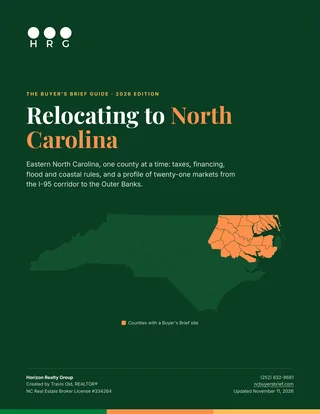
Twenty-one dossiers, one honest rule: every claim on this panel is published — with sources — on that county's own brief site. Tap a green county on the map, a chip in the lanes, or a quiz result.