← Relocating to NC Columbus
Southeast Inland · County guide
Columbus County, North Carolina
“A county on the South Carolina line, where the state-owned lake, the Lumber River flood record and a county land use ordinance with a farm exemption shape a purchase.”
 By Travis Old, broker and builder. Drafted with Melinda, an AI assistant. How we write
The full Columbus County Buyer’s Brief site is not live yet. This page is a county guide in the meantime; listings and the full county briefs arrive with the site.
Horizon Realty Group helps with a search in Columbus County directly or through its agent referral network. Travis Old stays your point of contact.
Columbus County is in the southeastern corner of the state on the South Carolina line, with Whiteville as the county seat and Tabor City, Chadbourn and Lake Waccamaw among the towns on the NC Department of Revenue rate table. Its neighbors in North Carolina are Bladen, Robeson, Brunswick and Pender counties, and the Census Bureau's adjacency list also shows Horry and Dillon counties in South Carolina. The state's licensed-hospital list of March 5, 2026 shows Columbus Regional Healthcare System at 500 Jefferson Street in Whiteville with 154 general hospital beds. NC Commerce ranked Columbus a Tier 1 county for 2026. For school information, use the NC DPI school report cards.
Property tax has a county layer and a town layer. The bill is the county rate, plus a town rate inside Whiteville, Tabor City, Chadbourn or Lake Waccamaw, plus a county fire or rescue district outside the towns. Ask the county tax office which districts apply to a given parcel, and check the parcel's current figure against the county's own tax record. Current county, town and district rates are in the table on this page.
At a glance
- County property tax rate (FY2026-27)
- $0.805 per $100before any town rate
- Coastal (CAMA) permit county
- No
- Financing reference
- Conforming loan limit, one unit (2026)
- $832,750
- FHA loan limit, one unit (2026)
- $541,287
Tax rate: NCDOR, verified November 12, 2026; town rates and any district rates on file are in the table below. Loan limits: FHFA and HUD, verified November 3, 2026.
The county's land use rules are a single county ordinance rather than a separate zoning code for each area. Columbus County's Land Use Regulations Ordinance, which the posted copy says the commissioners approved and adopted on February 21, 2022, applies to unincorporated areas outside any municipality's extraterritorial planning jurisdiction, exempts the towns and their extraterritorial areas unless they adopt it, and exempts bona fide farm operations. It divides the county into two zoning areas, the Southeastern Community College Zoning Area and the General Use District Zoning Area, refers to an Official Zoning Map, and leaves a use it does not list to a determination by the Planning Director. Inside a town, the town's own rules apply, so ask the county planning office, or the town, which set of rules covers an address. On rural lots without sewer, septic systems go through the local health department's improvement permit, and G.S. 130A-335 also allows a licensed soil scientist to evaluate a proposed site.
Flood information starts with the Lumber River. The National Weather Service gauge at Fair Bluff (FBLN7) does not publish flood stage categories, but its recorded crests include 17.03 feet on September 19, 2018 and 16.67 feet on October 12, 2016, and the Weather Service's impact statement for 17 feet says much of Fair Bluff is flooded, with water in many buildings and many roads impassable. FEMA's Community Status Book, refreshed August 25, 2026, shows an effective flood map date of December 6, 2019 for the county, Whiteville, Tabor City, Lake Waccamaw and Fair Bluff, and February 16, 2007 for Chadbourn and Bolton. It lists Whiteville at Community Rating System Class 9, a 5 percent discount, effective May 1, 2020, and shows no class for the county or the other towns. Check each parcel in the NC Flood Risk Information System.
Lake Waccamaw, beside the town of the same name, is one of the seven state lakes named in the state parks rules (07 NCAC 13C). Rule .0301 says no structure may be built upon the floor of, erected in or floating upon a state lake without a state lake permit, applied for at the park office that manages the lake and renewed each year, and G.S. 146-13 makes erecting a dock, pier or other structure on a state lake without a permit a Class 3 misdemeanor. Rule .0303 sets structural limits, including a 225-foot length for a private pier and an overall structure height of 15 feet above the floor level, so confirm any existing pier's permit status and how it transfers before an offer. Historic properties here are National Register listings: the Tabor City Commercial Historic District (listed December 15, 2015), the Columbus County Courthouse, the Lake Waccamaw Depot and the Culbreth House in Whiteville; the State Historic Preservation Office's list shows no National Register district in Whiteville. National Register listing by itself does not add local design review; ask the town or the county whether a particular house sits in a locally regulated district, and a North Carolina attorney can say what a listing means for a given contract.
| At a glance | The documented facts | Source |
|---|---|---|
| County property tax rate, FY2026-27 | $0.805 per $100 of assessed valuebefore any town, fire-district or service-district rate | NC Department of Revenue rate tables |
| Countywide reappraisal | Latest 2021; next scheduled 2029values are reset countywide in a reappraisal year | NC Department of Revenue rate tables |
| Town tax rates, FY2026-27 | Boardman $0.05, Bolton $0.60, Brunswick $0.42, Cerro Gordo $0.20, Chadbourn $0.62, Fair Bluff $0.65, Lake Waccamaw $0.30, Sandyfield $0.35, Tabor City $0.60, Whiteville $0.59 per $100added to the county rate inside town limits | NC Department of Revenue rate tables |
| Fire and service district rates | 22 district rates on file, from $0.02 to $0.30 per $100added where a parcel sits inside the district; other districts may apply, so ask the tax office which ones a parcel is inShow all 22
| NC Department of Revenue rate tables |
| Lumber River at Fair Bluff, recorded crests | 17.03 ft on September 19, 2018; 16.67 ft on October 12, 2016the gauge publishes no flood stage categories; 17 ft impact: much of Fair Bluff flooded | National Weather Service gauge FBLN7 |
| FEMA map effective dates and Community Rating System | County, Whiteville, Tabor City, Lake Waccamaw, Fair Bluff December 6, 2019; Chadbourn, Bolton February 16, 2007; Whiteville CRS Class 9 (5%)no class listed for the county or the other towns | FEMA NFIP Community Status Book, refreshed August 25, 2026 |
| County land use rules | Land Use Regulations Ordinance outside town jurisdictions; bona fide farms exemptadopted February 21, 2022 per the posted copy; confirm the parcel with the county planning office | Columbus County, Land Use Regulations Ordinance |
| Structures on Lake Waccamaw | State lake permit required, applied for at the park office; renewed yearlyprivate pier length limit 225 ft; overall height 15 ft above the floor level (rule .0303) | NC State Parks, State Lake Regulations (07 NCAC 13C) |
| Licensed hospital | Columbus Regional Healthcare System, Whiteville: 154 general bedsstate list as of March 5, 2026 | NC DHSR, Hospitals by CountyAs of March 5, 2026 |
| County tier, 2026 | Tier 1 | NC Commerce, 2026 county tier designationsAs of November 26, 2025 |
Sources
Read as of November 12, 2026, unless another date is shown.
Show all 13 sources
- NC Department of Revenue: county rates and reappraisal schedule, FY2026-27, as of November 11, 2026
- NC Department of Revenue: county and municipal rates, effective rates and special district rates, FY2026-27
- National Weather Service: Lumber River at Fair Bluff (FBLN7), crests and impacts
- FEMA OpenFEMA: NFIP Community Status Book
- Columbus County: Land Use Regulations Ordinance
- NC State Parks: State Lake Regulations (07 NCAC 13C)
- N.C. Gen. Stat. 146-13: permit for piers and docks on state lakes
- N.C. Gen. Stat. 130A-335: wastewater systems and site evaluations
- NC Division of Health Service Regulation: hospitals by county, as of March 5, 2026, as of March 5, 2026
- NC State Historic Preservation Office: National Register listings by county
- NC Commerce: county distress rankings (tiers), as of November 26, 2025
- U.S. Census Bureau: county adjacency file
- NC School Report Cards (NC Department of Public Instruction), as of November 11, 2026
A builder’s observations
If you plan to build or renovate here
One owner, two companies. Travis Old is a licensed North Carolina real estate broker with Horizon Realty Group and the President of Two Sons Construction, LLC, a licensed general contractor. You are never required to use one to work with the other. For Columbus County, these are questions for a local licensed contractor, and Travis reads a house or lot as a builder would.
Permits and zoning vary by jurisdiction
Setbacks, lot coverage and permit timelines differ between a county and the towns inside it. Confirm them with the planning office before a design is priced.
Utilities decide what has to be tested
Whether public water and sewer reach a lot decides what needs permitting, drilling or testing. Ask the county or town utility office early.
General observations for this kind of county, not advice about a particular property. Rules change. Confirm each one with the office that administers it.
When the site launches
Tell me when the Columbus County site launches
One email when the Columbus County Buyer’s Brief goes live, and sooner if Travis can already help with your search.
Neighboring counties
- BladenA Cape Fear River county with a state lake and a state private-well sampling program under a 2019 consent order.County guide
- RobesonA river county on I-95 where the Lumber River flood record, the Lumberton levee, an interstate widening and a county zoning office define the questions to ask.County guide
- BrunswickSix separate barrier-island towns, a mainland corridor across the Cape Fear River from Wilmington, and a tax and flood stack that changes from one town line to the next.County guide
- PenderThe Pender end of Topsail Island, the fast-building Hampstead and Scotts Hill mainland on U.S. 17 toward Wilmington, and an inland county seat, all on a tax bill that resets one year late.County guide
The free guide
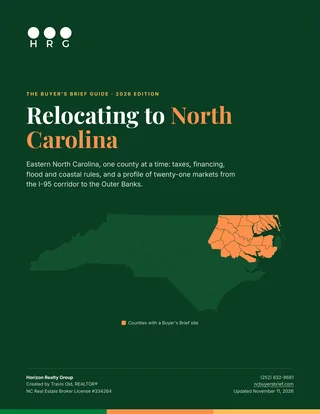
Relocating to North Carolina
A free guide to moving here: what the move does to your taxes, how financing and flood rules change by county, how to choose between twenty-one eastern North Carolina markets, and a page on each one.
- The North Carolina tax picture, with the official source for every figure
- Loan limits, coastal permits and flood questions that change by county
- A side-by-side comparison of every market, then a profile of each
- A checklist for the first month in your new county